China Trend Report for Luxury Brands 2023: graduating from private traffic to CRM
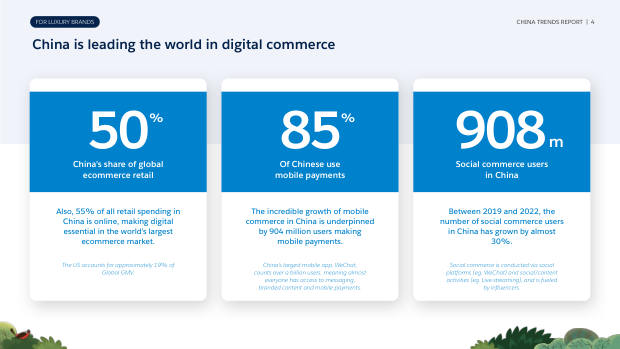
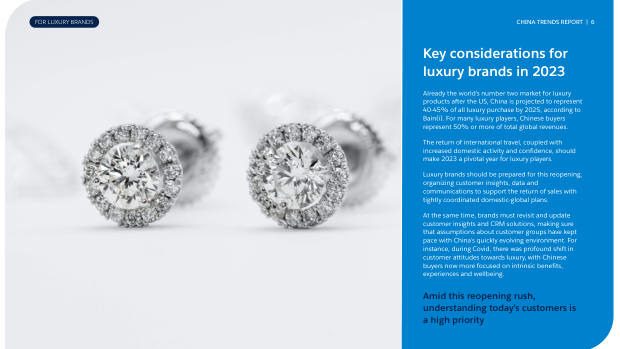
China is already the world's second-largest luxury market after the US, and Bain projects it will account for 40–45% of all luxury purchases by 2025; for many houses, Chinese buyers already represent 50% or more of global revenue. With international travel reopening in 2023 and more than 34% of luxury sales in China taking place online in 2022, the report frames the year as a pivot point — one that rewards brands with coordinated domestic-global customer data over those still running channel-by-channel.
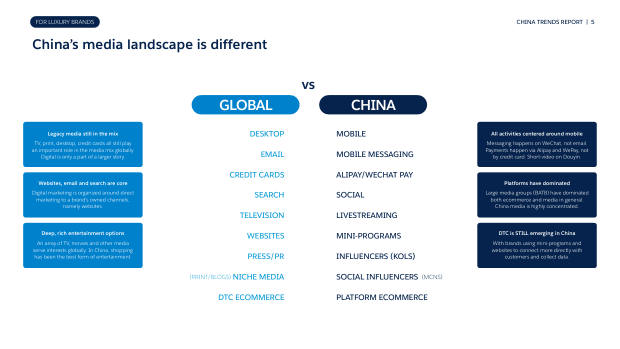
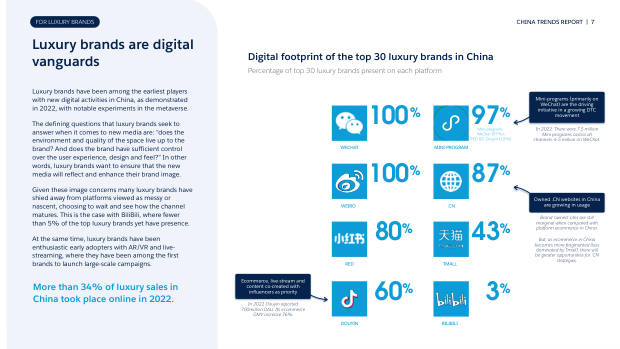
Luxury brands are the market's digital vanguards, having been among the first into AR/VR, large-scale livestreaming and 2022's metaverse experiments. But that appetite is selective: image control keeps luxury off platforms it judges nascent (fewer than 5% of top luxury brands have a Bilibili presence), while it concentrates spend on WeChat, RED and Tmall. The strategic shift Totem records for 2023 is away from awareness-buying and toward retention, service and repeat purchase.
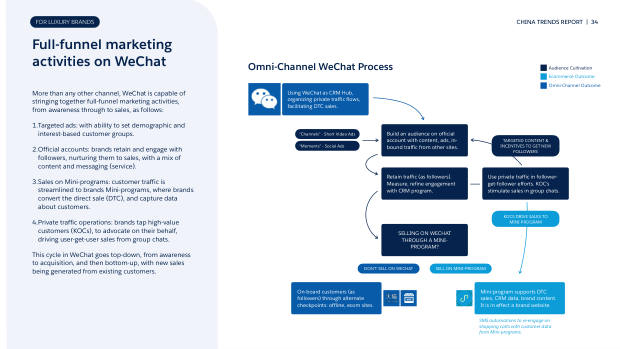
The through-line is CRM. Luxury has moved furthest of any category from tactical "private traffic" toward a genuine single customer view, and the report positions private traffic as a first step rather than the destination. WeChat sits at the centre as the combined communications, commerce and CRM hub, with Mini-programs supplying the direct data-capture layer.
Luxury leads the market on CRM maturity.
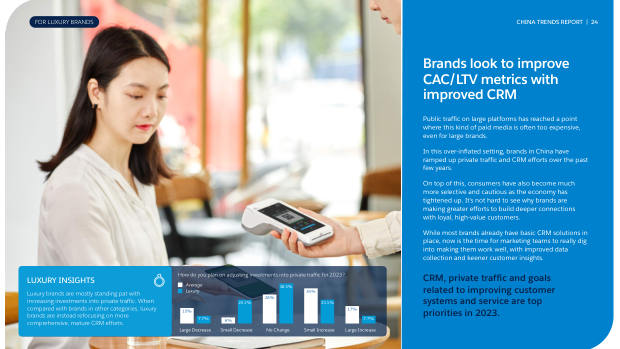
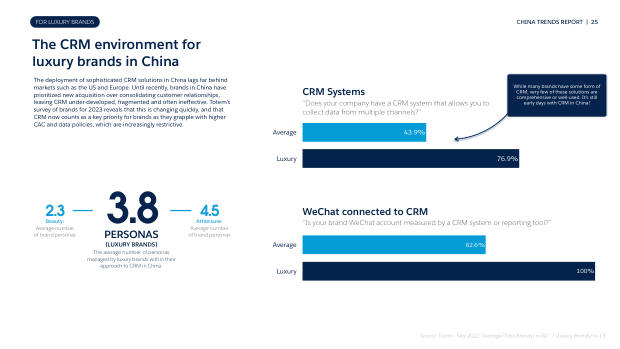
76.9% of surveyed luxury brands operate a CRM that collects data across channels (vs a 43.9% cross-category average), and 100% have WeChat tied to CRM (vs 62.6%). Rather than pour more into private traffic, luxury is standing pat there and refocusing on a comprehensive single customer view.
WeChat is the focus channel, not just a comms channel.
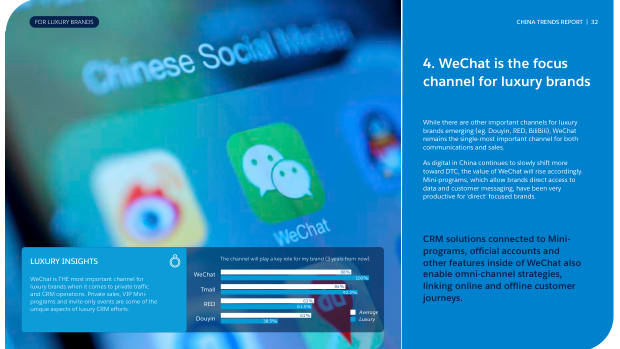
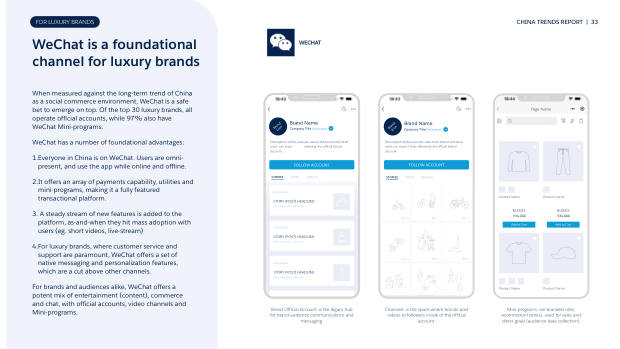
All of the top 30 luxury brands operate an official account and 97% run a WeChat Mini-program. Asked which channels will matter in three years, 100% of luxury respondents named WeChat and 92.3% named Tmall — above the cross-category averages of 88%.
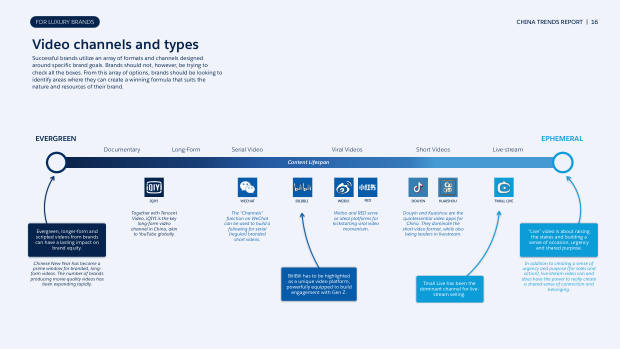
Luxury under-indexes on the video platforms.
Only 60% of the top 30 luxury brands are on Douyin and future-importance scores run below average — Douyin 38.5% (vs 63%) and RED 61.5% (vs 84%) — reflecting a deliberate wait-and-see on channels judged too messy for brand image. Bilibili presence sits at roughly 3%.
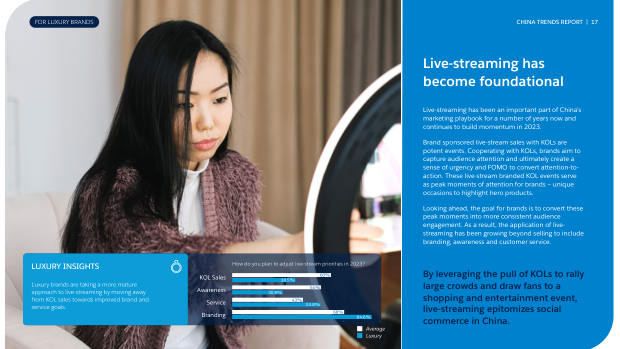
Livestreaming shifts from selling to service and story.
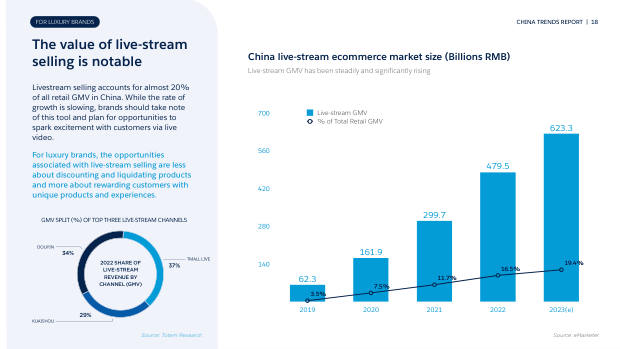
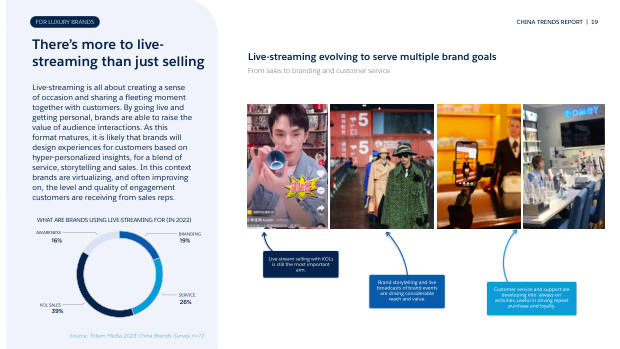
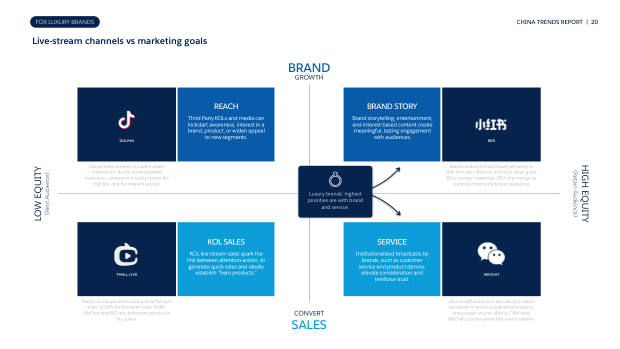
For luxury the value of live-stream is less about discounting or liquidating stock and more about rewarding customers with unique products and experiences. Reported priorities skew toward brand and service rather than pure KOL sales, even as KOL events remain the peak-attention moments for hero products.
Private traffic is a stepping stone, not the goal.
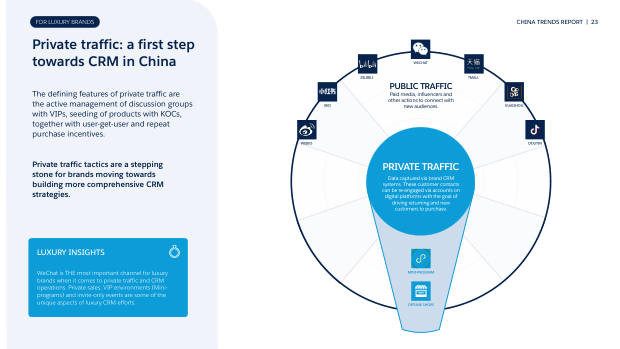
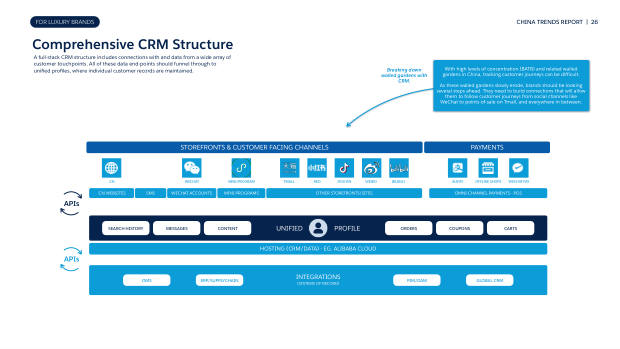
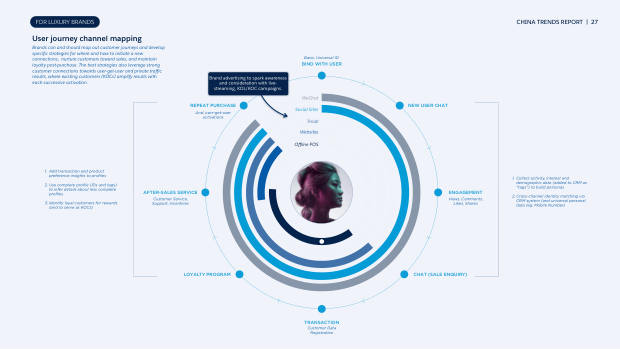
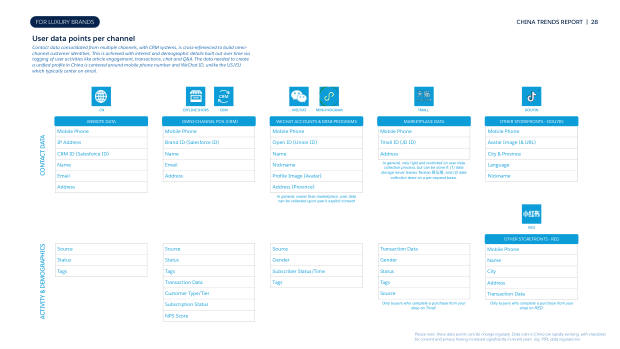
With public-platform media now too expensive even for large brands, luxury has built private-traffic operations around VIP groups, KOC seeding and user-get-user incentives — but the report is explicit that these tactics must "graduate" into full-stack CRM that unifies WeChat, Tmall, offline POS and .CN into single profiles.
The market demands more customer touchpoints than the West.
Where a typical US consumer engages 3–4 touchpoints before buying, in China the figure is 15–20 — making social commerce the stage where luxury must supply proof and reassurance in the same space where the transaction happens.
Reopening makes coordinated domestic-global CRM urgent.
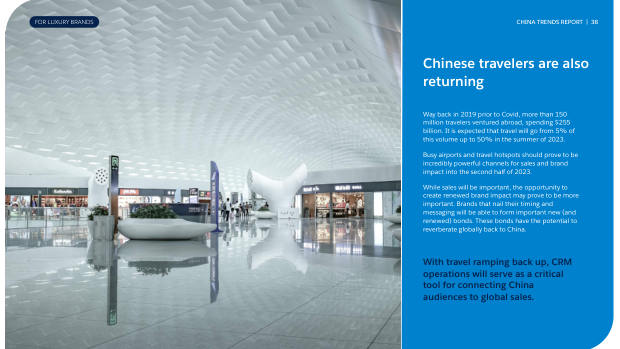
With outbound travel projected to climb from roughly 5% of pre-Covid volume to 50% by summer 2023, and 2019 seeing 150m+ Chinese travellers spend $255bn abroad, CRM becomes the tool that links a customer met in an airport boutique to a sale booked back home.





How big is China for luxury brands?
It is the world's second-largest luxury market after the US, projected by Bain to represent 40–45% of all luxury purchases by 2025; for many houses Chinese buyers already account for 50% or more of global revenue.
Which channel matters most for luxury CRM in China?
WeChat. Every one of the top 30 luxury brands runs an official account and 97% operate a Mini-program, which supplies the direct data capture behind CRM. 100% of surveyed luxury brands have WeChat connected to their CRM.
Are luxury brands ahead on CRM?
Yes. 76.9% of surveyed luxury brands run a multi-channel CRM versus a 43.9% cross-category average, and they manage the most customer personas of the three categories at 4.5 on average.
Why are luxury brands cautious about platforms like Bilibili and Douyin?
Image control. Luxury waits for channels to mature before committing — fewer than 5% of top luxury brands are on Bilibili — and rates Douyin's future importance at just 38.5% versus a 63% average.
Who produces the report and what is the sample?
It is a joint Salesforce and Totem study, drawing on Totem's survey of 82 China brands (Nov 2022), of which 13 were luxury brands, most with more than 10 years' experience in China.
This is a co-branded China Trend Report published jointly by Salesforce and Totem Media, part of a series examining CRM and social commerce by category. It draws on Totem's annual survey of marketing leaders at 82 mostly-global brands — spanning very large to medium-sized companies, most with more than 10 years in China — conducted at the end of 2022 on their 2023 plans. The luxury cut reflects the 13 luxury brands within that sample (n=13), supplemented by Totem's platform research on the digital footprint of the top 30 luxury brands and third-party sources including Bain, eMarketer and Group M.
Get the full report
Leave your details — we'll email you the PDF and give you the download straight away.