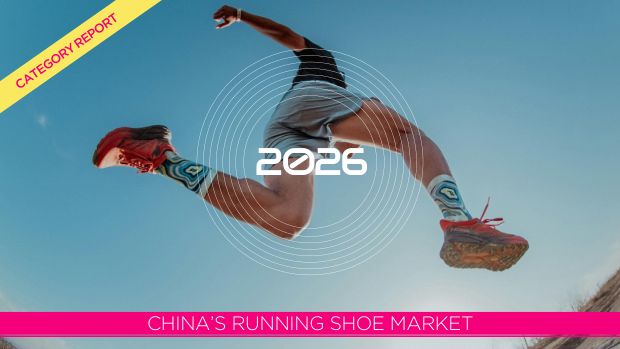
China's Running Shoe Market 2026: a K-shaped category where specialists take the premium
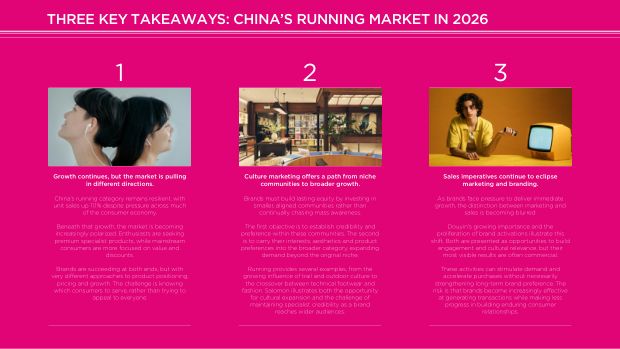
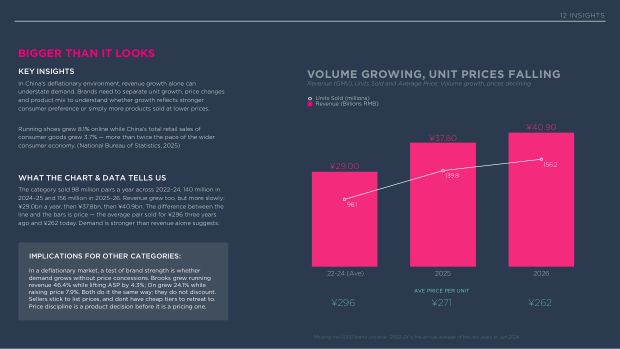
China's running shoe category is bigger than the headline sales figures suggest. Over the past year revenue grew about 8%, but the number of pairs sold grew 11.1% — faster than the wider consumer economy (running grew 8.1% online versus 3.7% for total retail) and against a deflationary backdrop where the average pair fell from ¥296 three years ago to ¥262 today. Demand is stronger than revenue alone implies.
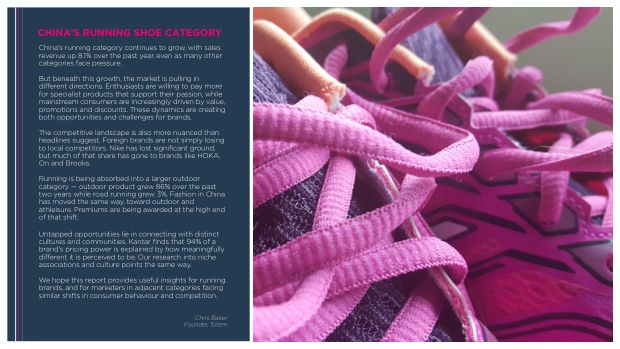
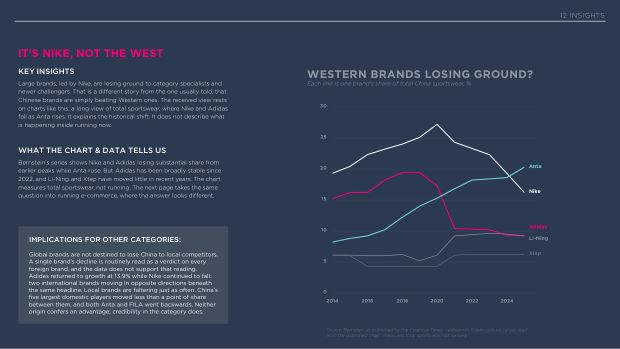
Beneath the growth, the market is pulling in two directions. Committed runners are trading up into specialist brands that sell on credibility rather than price, while mainstream buyers trade down toward value and discounts. Both ends are growing in a K-shape; the middle is where growth stalls. Foreign brands aren't simply losing to local players — Nike has given up significant ground, but much of it has gone to HOKA, On and Brooks, and running itself is being absorbed into a larger outdoor shift (outdoor product grew 86% in two years against 3% for road running).
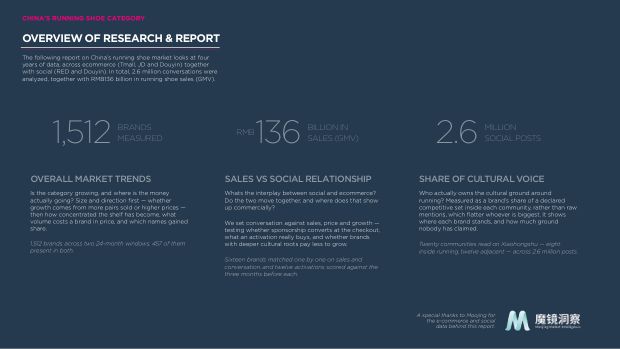
Totem's report reads the category across four years of Moojing e-commerce and social data — Tmall, JD and Douyin alongside RED and Douyin — spanning RMB136 billion in GMV, 2.6 million social posts and 1,512 brands, and it introduces Share of Cultural Voice (SOCV) across twenty Xiaohongshu communities. The throughline: pricing power follows meaningful difference, and the brands that win invest in aligned communities rather than chasing mass awareness.
Bigger than it looks.
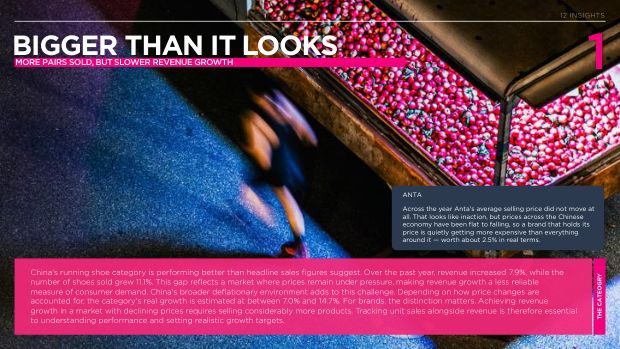
Units grew 11.1% while revenue grew about 8%, as the average price fell. Volume rose from 98 million pairs a year to 156 million, and real category growth is an estimated 7–15%. In a deflationary market, track unit sales, not just revenue.
The shelf is shrinking.
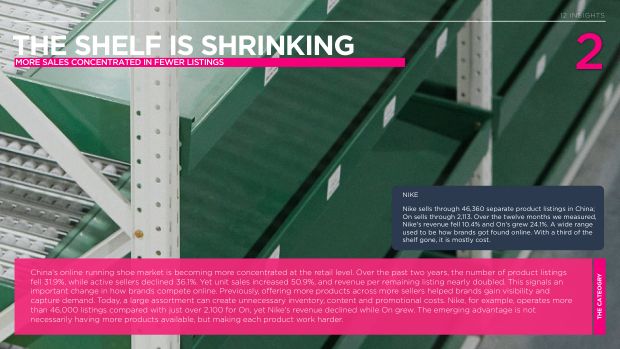
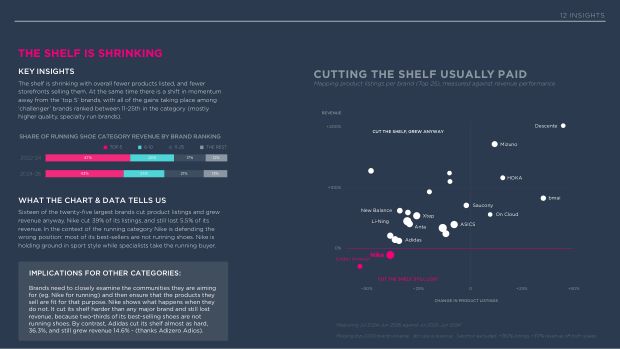
Product listings fell 31.9% and active sellers 36.1%, yet unit sales rose 50.9% and revenue per remaining listing nearly doubled. A wide assortment is now mostly cost: Nike runs 46,360 listings to On's 2,113 — and Nike's revenue fell 10.4% while On's grew 24.1%.
The gains sit with the challengers.
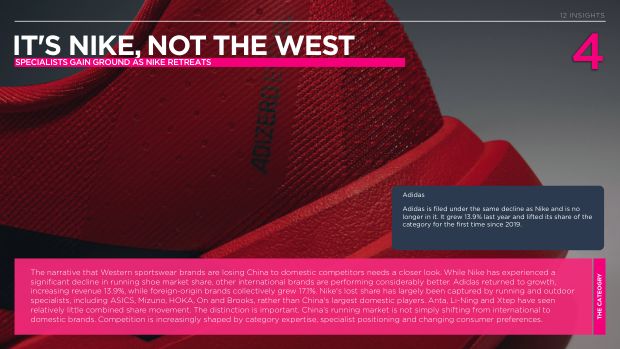
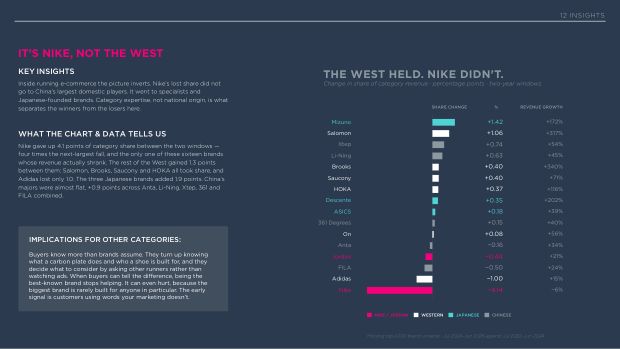
Momentum has moved away from the top-five brands toward challengers ranked 11–25 — mostly higher-quality specialist run brands. Sixteen of the 25 largest brands cut listings and grew revenue anyway; Adidas cut its shelf 36% and still grew 14.6%, on the back of the Adizero Adios.
Nike is defending the wrong position.
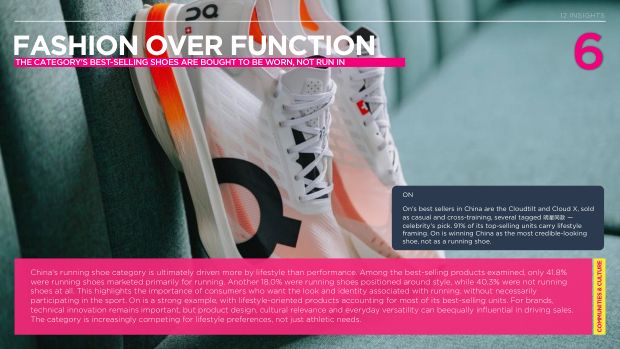
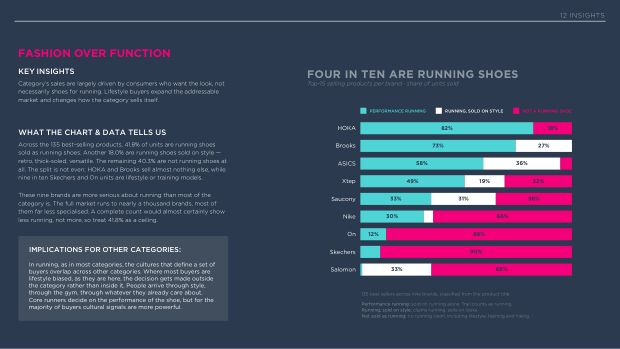
Nike cut its shelf harder than any major brand and still lost revenue, because two-thirds of its best-sellers aren't running shoes. It's holding sport-style ground while specialists take the running buyer.
Specialists win premium; mass buyers seek value.
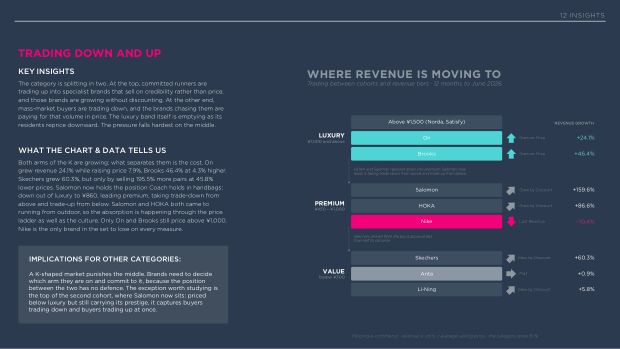
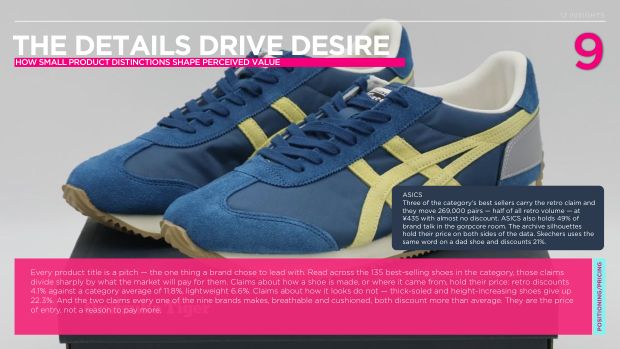
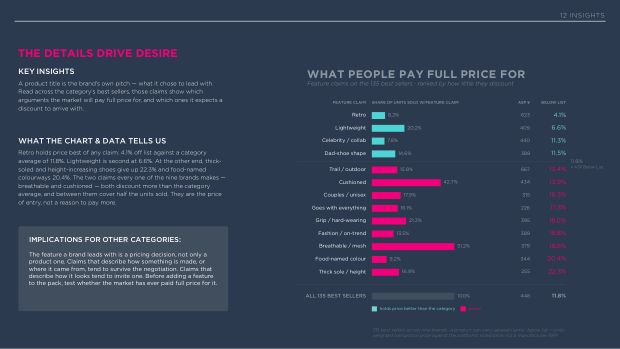
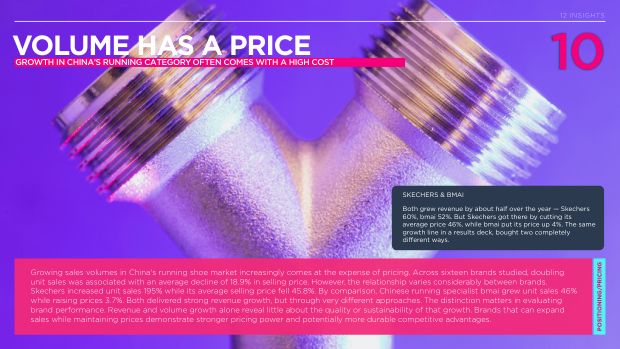
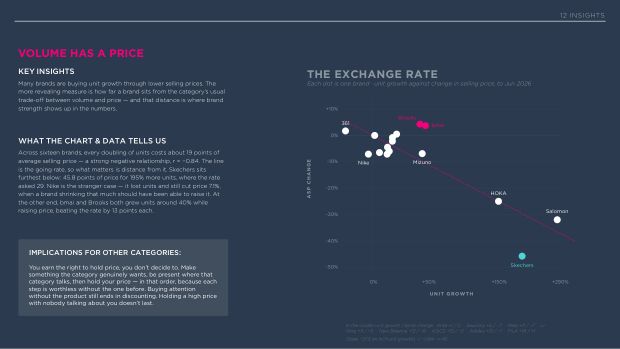
The category is splitting on sharp pricing lines. Brooks grew revenue 46.4% while lifting ASP 4.3%; On grew 24.1% while raising price 7.9% — both by refusing to discount. Price discipline is a product decision before it is a pricing one.
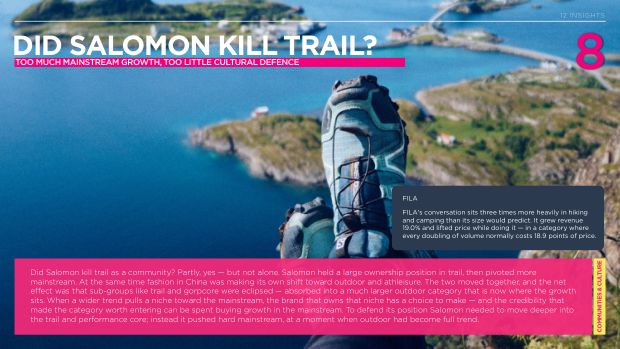
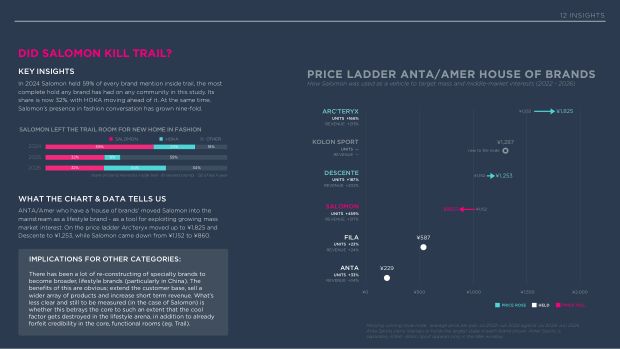
Salomon's “Coach position.”
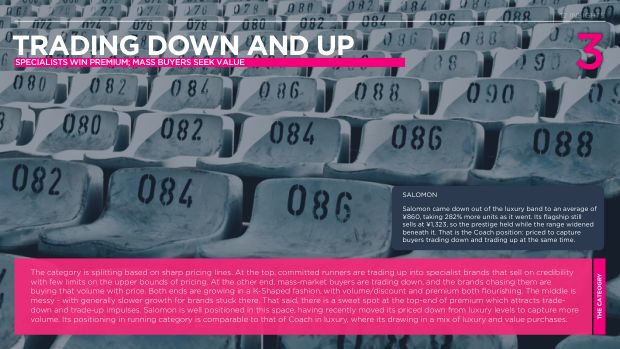
Salomon came down out of the luxury band to an average ¥860 and took 282% more units, while its flagship still sells at ¥1,323 — prestige held as the range widened beneath it, pulling trade-down and trade-up at once. It also shows the challenge of keeping specialist credibility while reaching wider audiences.
Running is being absorbed into outdoor.
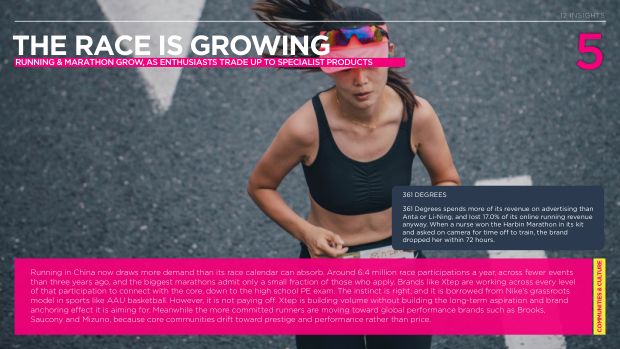
Outdoor product grew 86% over two years against 3% for road running, and fashion has moved the same way toward outdoor and athleisure — with premiums awarded at the high end of that shift.
Culture is the path from niche to scale.
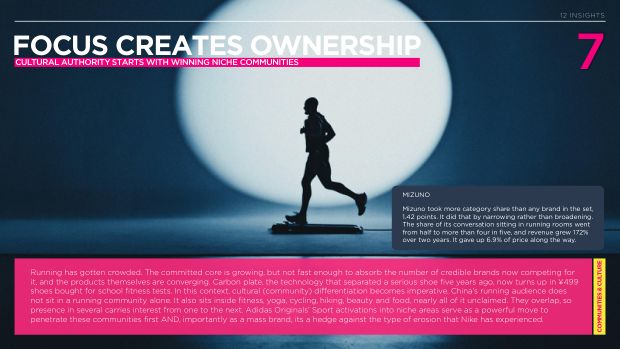
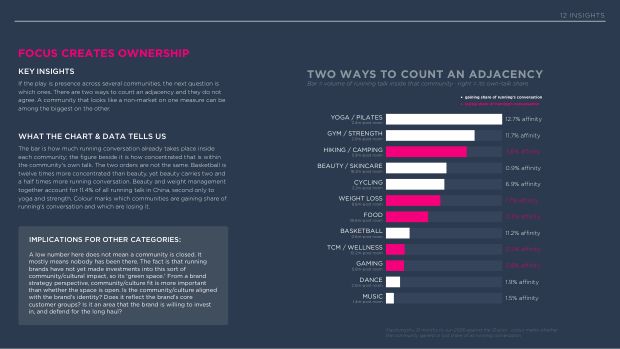
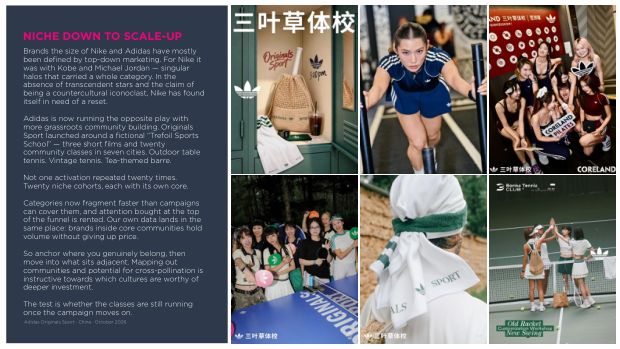
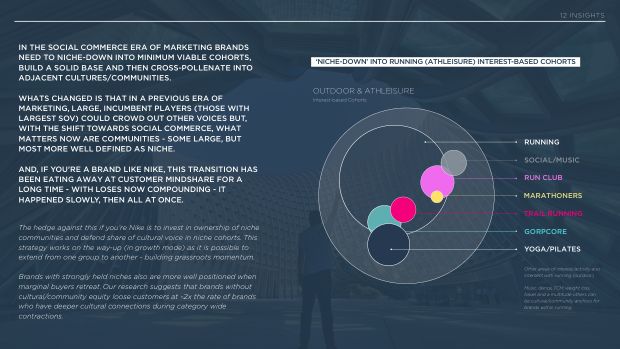
Kantar finds 94% of a brand's pricing power is explained by how meaningfully different it is perceived to be. Measured through Share of Cultural Voice across 20 Xiaohongshu communities, the winners build credibility inside smaller, aligned communities first, then carry that taste into the broader category.
How big is China's running shoe market?
The report analyses RMB136 billion in running-shoe GMV across four years. The category sold roughly 156 million pairs in the latest year for about ¥40.9 billion in revenue, growing faster in units (+11.1%) than in revenue as prices fell.
Is the category still growing?
Yes — and faster than the wider economy. Running shoes grew 8.1% online versus 3.7% for total retail sales. But it's a K-shaped market: premium specialists and value/discount brands both grow while the middle stalls.
Is Nike losing to local Chinese brands?
Not simply. Nike has lost significant share, but much of it has gone to specialist foreign brands — HOKA, On and Brooks — that sell on credibility and don't discount. Nike's own issue is that two-thirds of its best-sellers aren't running shoes.
What is Share of Cultural Voice (SOCV)?
Totem's measure of how much of a declared competitive set a brand owns inside a given community — rather than raw mentions, which flatter the biggest players. The report reads SOCV across twenty Xiaohongshu communities, eight inside running and twelve adjacent.
Who produced the report and what data is behind it?
Totem, using Moojing e-commerce and social data across Tmall, JD, Douyin and RED — 2.6 million social posts and 1,512 brands over four years. It pairs 16 brands one-to-one on sales and conversation and scores 12 activations against the three months before each.
Totem's 2026 category report on China's running shoe market, built on four years of Moojing e-commerce data (Tmall, JD, Douyin) and social data (RED, Douyin): 2.6 million conversations and RMB136 billion in GMV across 1,512 brands. It tests the sales–social relationship by matching sixteen brands one-to-one and scoring twelve activations against the three months before each, and measures Share of Cultural Voice across twenty Xiaohongshu communities (eight inside running, twelve adjacent). With thanks to Moojing for the e-commerce and social data.
Get the full report
Leave your details — we'll email you the PDF and give you the download straight away.