China's Pricing Gap: why Chinese brands are leaving billions on the table
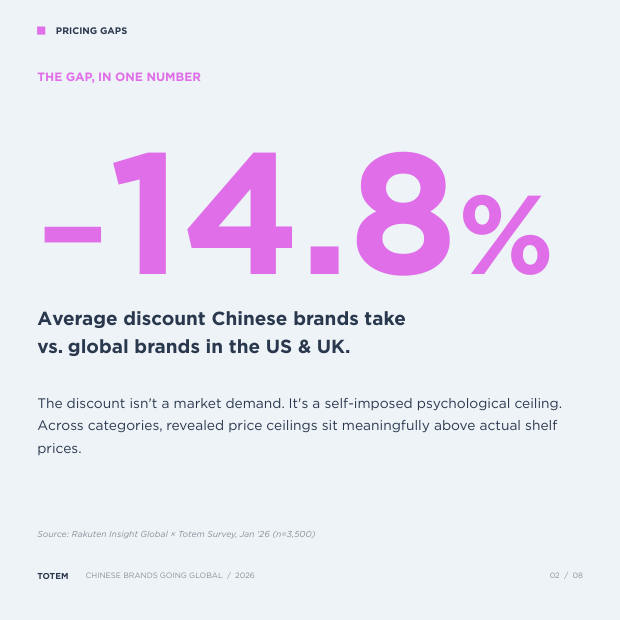
Chinese brands going global are leaving billions on the table — not because consumers won't pay more, but because the brands never ask. Across the US and UK, Chinese brands price an average of 14.8% below comparable global brands, and the gap runs far deeper in Asia: −29.6% in Japan and −29.0% in South Korea.
The discount isn't a response to market demand. It's a self-imposed psychological ceiling — and in Western markets it actively backfires, because consumers read an unusually low price as a signal that something is wrong. This snapshot maps the gap market by market, category by category, and lays out a three-year playbook for moving prices up.
The gap is global
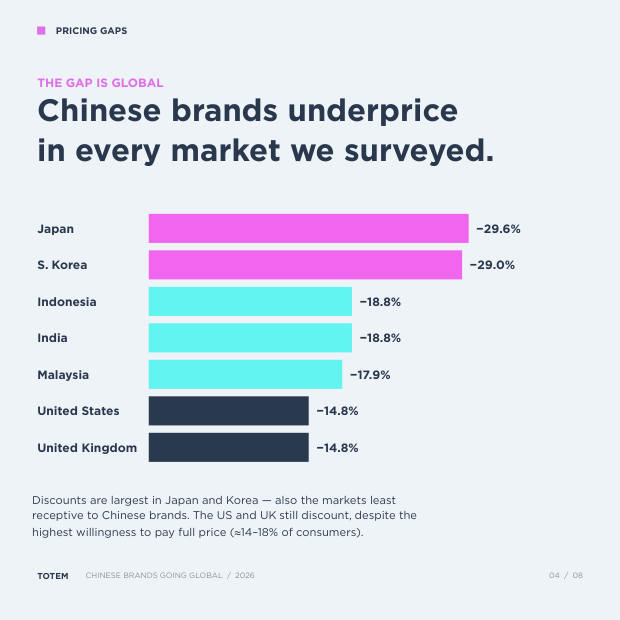
Chinese brands underprice in every market Totem surveyed — Japan −29.6%, S. Korea −29.0%, Indonesia and India −18.8%, Malaysia −17.9%, US and UK −14.8%. Discounts are largest in the markets least receptive to Chinese brands, and persist even where willingness to pay full price is highest.
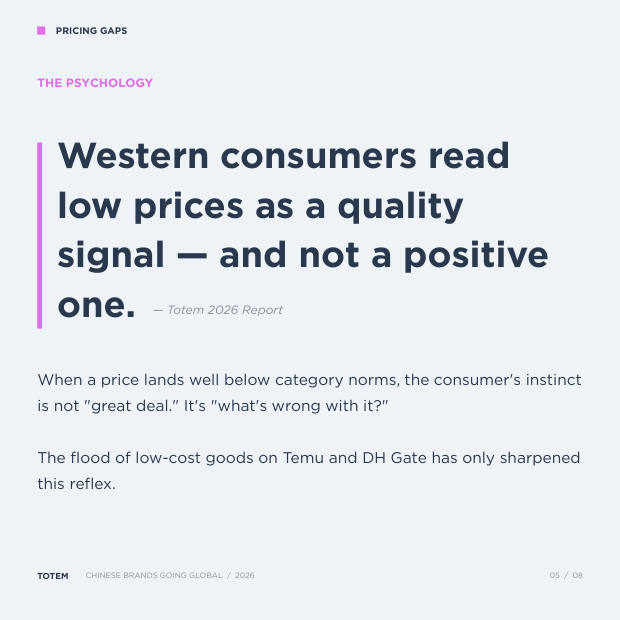
Low price reads as a warning, not a deal
When a price lands well below category norms, the Western consumer's instinct isn't 'great deal' — it's 'what's wrong with it?' The flood of low-cost goods on Temu and DHgate has only sharpened that reflex.
The headroom is real
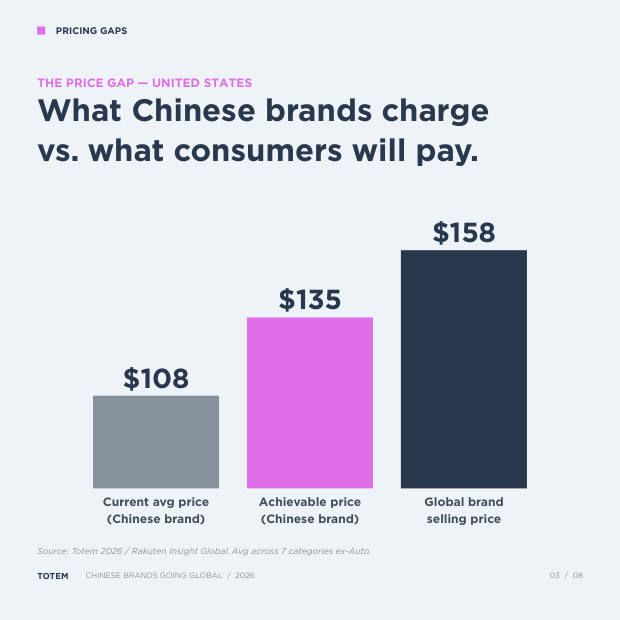
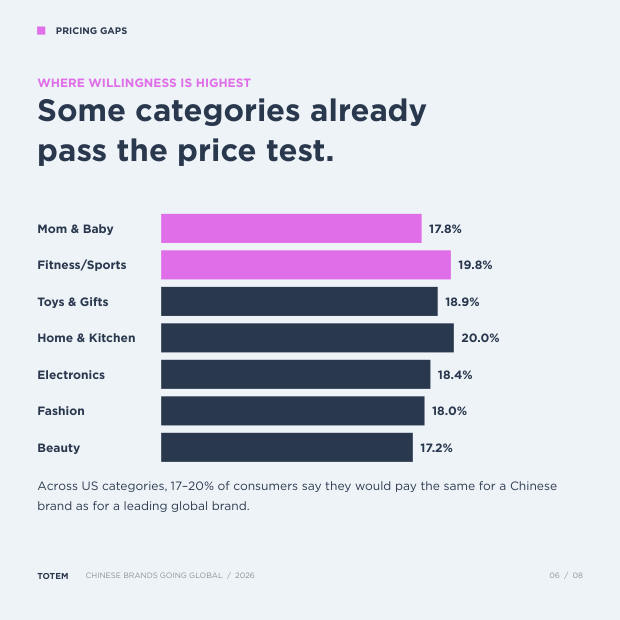
In the US, Chinese brands charge an average $108 where consumers say they'd accept $135, and global rivals sell the same categories at $158. Across US categories, 17–20% of consumers would pay the same for a Chinese brand as for a leading global one.
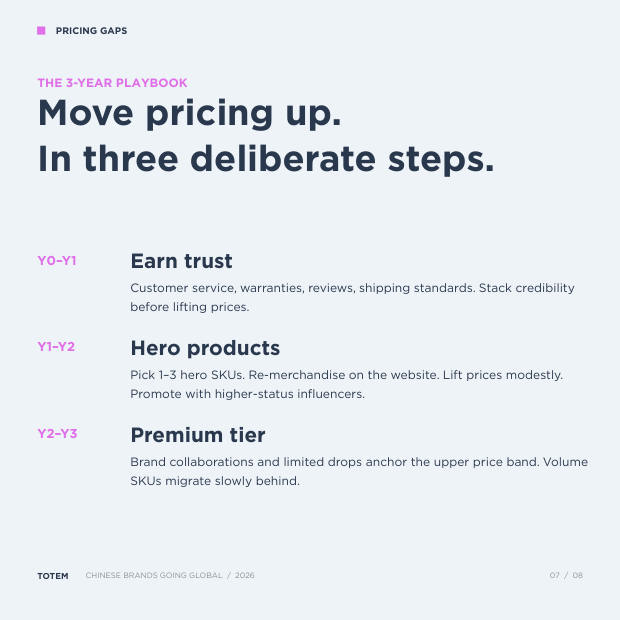
A three-year playbook
Move pricing up in deliberate steps: Y0–Y1 earn trust (service, warranties, reviews, shipping); Y1–Y2 build 1–3 hero SKUs, re-merchandise and lift prices modestly with higher-status influencers; Y2–Y3 anchor a premium tier with collaborations and limited drops as volume SKUs migrate up behind them.
How much do Chinese brands underprice global rivals?
By an average of 14.8% in the US and UK, rising to 29.6% in Japan and 29.0% in South Korea — a gap Totem measured across seven categories against comparable global brands.
Why does discounting hurt Chinese brands in Western markets?
Western consumers use price as a quality signal. A price well below category norms triggers suspicion rather than enthusiasm — an instinct sharpened by the flood of ultra-cheap goods on marketplaces like Temu and DHgate.
Which categories can already support higher prices?
Across US categories, 17–20% of consumers say they'd pay the same for a Chinese brand as a global leader, with Home & Kitchen, Fitness/Sports and Toys & Gifts among the most receptive.
Based on the Rakuten Insight Global × Totem survey of 3,500 consumers across seven markets (January 2026), with revealed price ceilings compared against actual shelf prices across seven consumer categories ex-Auto. Part of Totem's 2026 Chinese Brands Going Global program.
Get the full report
Leave your details — we'll email you the PDF and give you the download straight away.